
Past Simple vs Past Continuous vs Past Perfect?
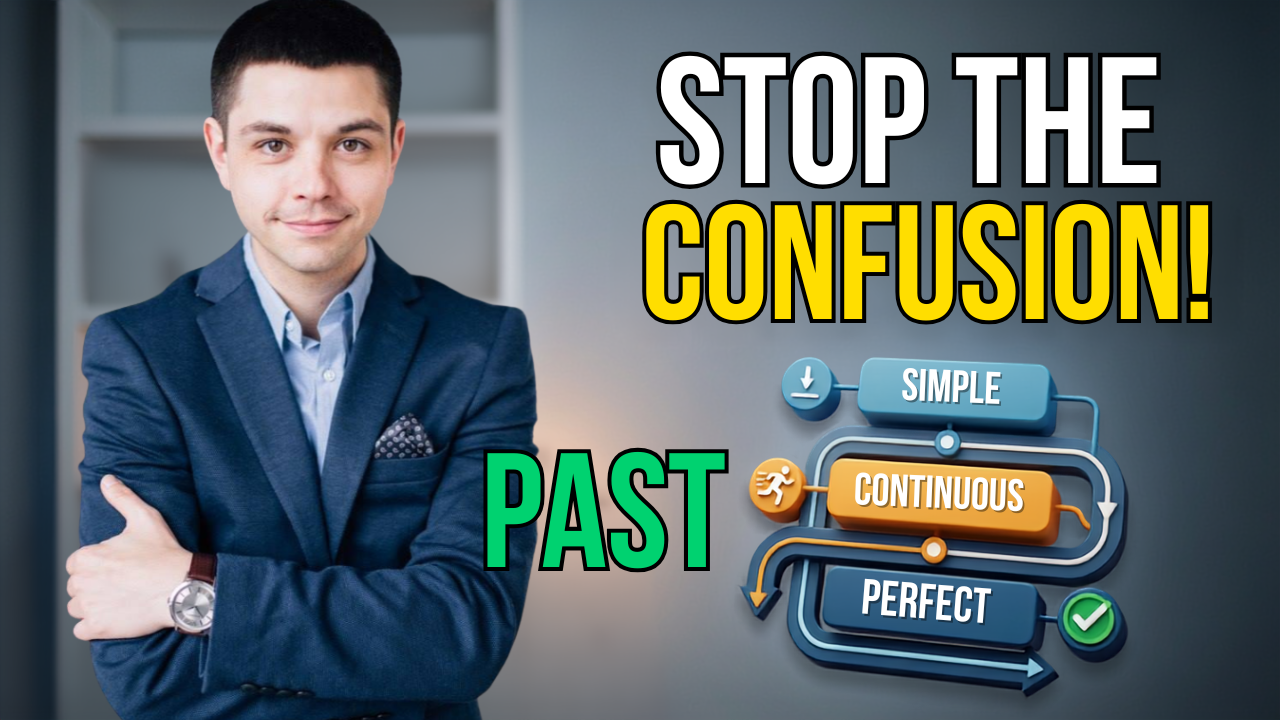
🚀 What's the Difference Between Past Simple, Past Continuous, and Past Perfect?
You tell a story about yesterday, and halfway through you freeze because you don't know which past tense to use, and you just pick one and hope. Sound familiar? Let's fix that today, for good.
So this is one of the questions I get more than almost any other: "Chris, I know there are like three past tenses, but I have no idea which one to use when, and honestly, I just guess." And look, I get it, English has this habit of giving you three or four ways to say almost the same thing, and then acting surprised when you're confused. It's not you. It's English being English.
But here's the good news: once you see these three tenses as a timeline, not a grammar chart, it clicks. So that's exactly what we're going to do.
⚠️ The Myth: "These Tenses Are Basically Interchangeable"
A lot of students think past simple, past continuous, and past perfect are just three flavors of "it happened before now," so any one of them will do. They won't. Each one answers a different question about time, and mixing them up can actually flip the meaning of your sentence. Once you know the job each tense does, you'll never have to guess again.
🎯 Understand Native Speakers But Can't Speak Yourself?
If you understand what native speakers say but struggle to speak English fluently yourself, you're not alone. Discover the #1 reason why this happens and how to fix it.
🎥 Watch This Free 16-Minute Lesson🎯 The Three Past Tenses, One at a Time
Past simple is for something that happened and finished, done, over, no loose ends. You don't need to think about anything else happening around it. It's just: this happened, at some point in the past, and that's the whole story.
🦷 I brushed my teeth this morning.
🚗 She drove to work at 8am.
🍳 We cooked dinner last night.
Past continuous is for something that was already happening, in the middle of it, when something else came along. It's not finished at the moment you're talking about, it's mid-action, like a photo taken in the middle of a movie.
🦷 I was brushing my teeth when the phone rang.
🚗 She was driving to work when it started raining.
🍳 We were cooking dinner when you called.
Now this is the one that confuses people most, but it's actually the simplest idea once you see it: past perfect is for the thing that happened before another past thing. It's the past of the past. So if you're already telling a story in past simple, and you need to jump back even further, that's when past perfect steps in.
🦷 I had already brushed my teeth before I ate breakfast.
🚗 She had left for work before I woke up.
🍳 We had cooked dinner before you got home.
This is the classic combo, and once you get it, it's actually kind of fun to use. One thing was already in progress (past continuous), and then a shorter action cut right through it (past simple). Think of the continuous action as the background, and the simple action as the thing that pops into the scene.
🦷 I was brushing my teeth when the phone rang.
🚗 She was driving to work when the light turned red.
🍳 We were cooking dinner when the smoke alarm went off.
🚀 Ready to Speak English with Confidence in Just 30 Days?
Join thousands of ESL learners who have transformed their English speaking skills. Discover proven techniques that work for busy adults.
🎓 Register for Free Seminar: "How to Speak Better English in 30 Days"Now here's why past perfect actually matters, and it's not just a grammar rule for the sake of it. When you use past perfect next to past simple, you're telling your listener exactly which event came first, without them having to guess or ask. That's the whole job of this tense: keeping your timeline straight.
🦷 I had brushed my teeth before I checked my phone.
🚗 She had already left when I called the office.
🍳 We had finished cooking dinner when you finally showed up.
Now you might be thinking, "Chris, how am I supposed to remember which tense to use in the moment?" Fair question. So here's a shortcut: certain words are like little signs pointing you to the right tense.
⏰ Past Simple: yesterday, last week, in 2019, ago
🎬 Past Continuous: while, as, at that moment
⏪ Past Perfect: before, after, already, by the time
Here's a fun quirk of English learners fall into, not because they're careless, but because past simple just feels safe. So people say "I finished my homework before I watched TV" using past simple twice, and native speakers will understand you, no real damage done, but it doesn't tell your listener clearly which one came first. Swap the first verb for past perfect, "I had finished my homework before I watched TV," and now the timeline is crystal clear, no guesswork needed.
🔑 The Real Secret: It's a Timeline, Not a Chart
Here's what I want you to take away from all this: stop thinking of these three tenses as separate boxes you have to memorize. Think of them as one single timeline. Past perfect is further back. Past simple is the main event. Past continuous is the background action still going on when the main event happens. That's it, that's the whole system.
Once you see it as a timeline, you stop asking "which tense is correct here" and start asking "what actually happened first, and what was still happening." Answer that, and the grammar basically writes itself.
📧 Join Our English-Everyday Speaking Community
Get exclusive vocabulary lessons, pronunciation tips, and fluency strategies delivered directly to your inbox. Join thousands of ESL learners transforming their English skills!
📚 Your Homework This Week
Take one thing that happened to you yesterday, just one. Write three sentences about it: one in past simple (what happened), one in past continuous (what was already going on), and one in past perfect (what had already happened before that). Say all three out loud.
Do this with one story a day for the next week, and by the weekend, you won't be translating tenses in your head anymore, you'll just feel which one fits.
So, what's the difference between past simple, past continuous, and past perfect? Past simple is the finished event, past continuous is what was already in progress, and past perfect is what happened before all of it. Three tenses, one timeline, and now you know exactly where each one belongs.
🎙️ Watch the Full Lesson
Want to see me explain this whole system in more detail? Here's the full video:


